How to Fix a Leaky Outdoor Faucet (Hose Bib)
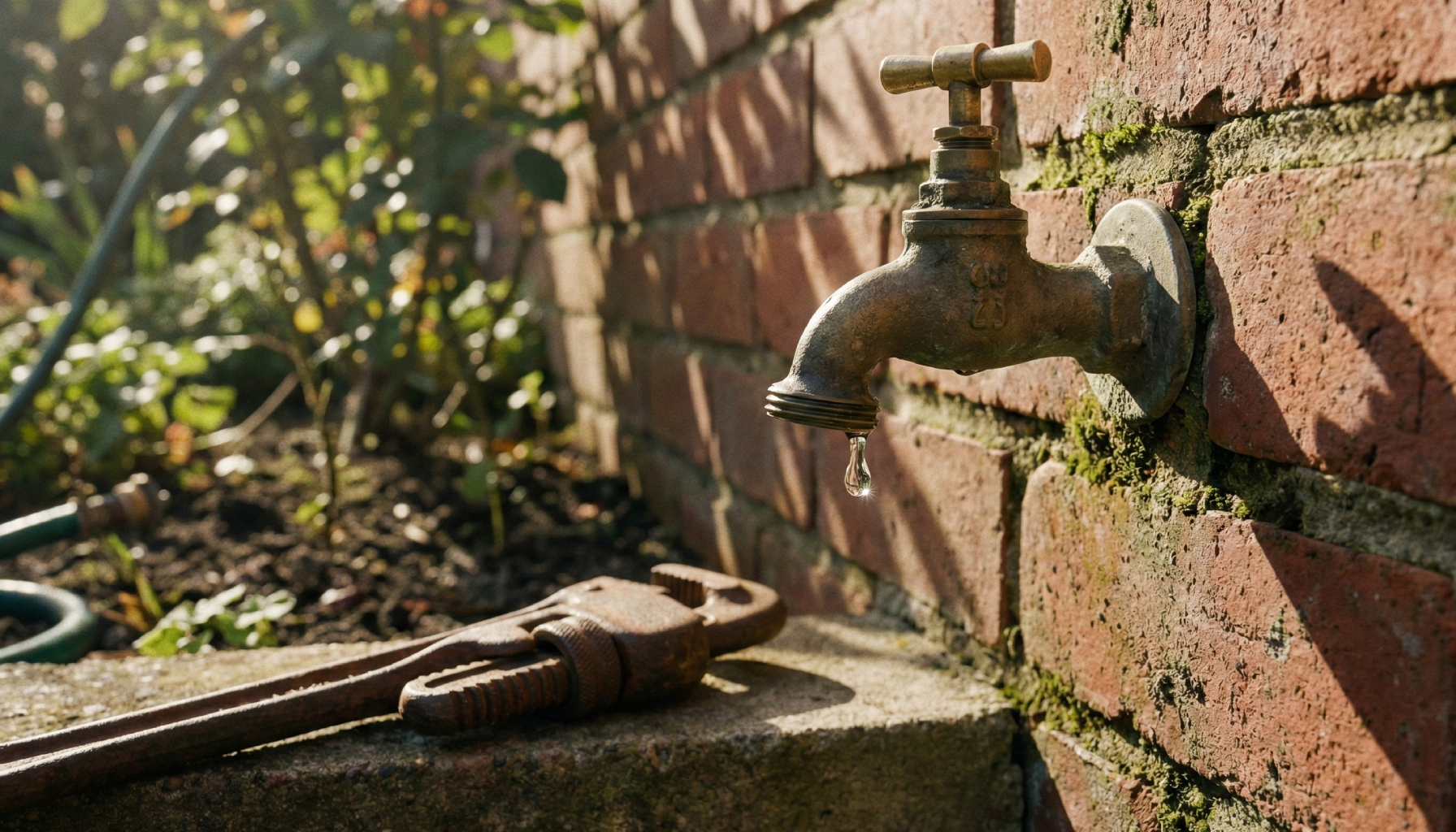
A leaky outdoor faucet wastes water and can damage your wall or foundation over time.
Most of the time, you can fix it yourself in under an hour with basic tools.
Pro Tip: Take a clear photo of your faucet and the inside parts as you take it apart.
This makes it much easier to put everything back in the right order.
Common Causes of a Leaky Outdoor Faucet
- Worn-out rubber washer
- Loose or worn packing around the stem
- Damaged O-ring
- Mineral buildup on parts
- Cracked or damaged faucet body (in this case, you may need a full replacement)
Safety and Prep
Before you start, plan to shut off the water to that faucet.
If it’s winter or near freezing, make sure you drain water from the line to avoid frozen pipes.
Tools You’ll Need
- Adjustable wrench (or a set of wrenches)
- Flathead screwdriver
- Phillips screwdriver (if needed)
- Plumber’s tape (Teflon tape)
- Replacement washers and/or O-rings (for outdoor faucet/stem)
- Packing string or packing washer (optional but helpful)
- Small wire brush or old toothbrush
- Bucket or small container (to catch water)
- Rag or paper towels
- Pen and paper (or phone) to note part sizes
Step 1: Turn Off the Water
- Locate the inside shutoff valve for the outdoor faucet (usually in the basement, crawlspace, or utility room).
- Turn the valve handle clockwise to shut off the water to the outside faucet.
- Open the outdoor faucet and let any remaining water drain out into a bucket or onto the ground.
Step 2: Remove the Faucet Handle
- Look at the top of the handle for a screw (it may be under a decorative cap).
- Pry off the cap (if there is one) with a flathead screwdriver.
- Unscrew the handle screw with the correct screwdriver.
- Pull the handle straight off the stem. If it’s stuck, wiggle and pull gently—do not force it too hard or you may bend the stem.
Step 3: Remove the Packing Nut and Stem
- Locate the packing nut just behind where the handle was (a hex-shaped nut around the stem).
- Use an adjustable wrench to turn the packing nut counterclockwise and remove it.
- Once the nut is off, pull the stem straight out of the faucet body.
- If it resists, wiggle it gently while pulling, but don’t twist too hard or you can damage the threads.
Step 4: Inspect the Washer and O-Ring
- At the end of the stem, look for a rubber washer held in place by a small screw.
- Unscrew the small screw and remove the washer. Check if it is cracked, hard, or worn down.
- Check for an O-ring on the stem (a round rubber ring near the middle or back).
- Slide off the O-ring if it looks cracked, flat, or brittle.
Step 5: Clean the Parts and Faucet Seat
- Use a small wire brush or old toothbrush to clean the stem threads and metal surfaces.
- Shine a flashlight into the faucet body and look at the “seat” (where the washer presses inside).
- Brush out any mineral buildup or debris inside the faucet body.
- Wipe everything with a rag to remove dirt and old bits of rubber.
Step 6: Replace the Washer and O-Ring
- Match the old washer and O-ring to new ones (same size and shape).
- If you’re not sure, take the old parts to a hardware store and match them there.
- Place the new washer at the end of the stem and tighten the small screw firmly, but do not strip it.
- Slide the new O-ring onto the stem in the same spot as the old one.
- Lightly coat the O-ring with water-safe plumber’s grease if you have it (optional but helpful).
Step 7: Refresh the Packing (to Stop Drips Around the Handle)
If water was leaking around the handle, the packing is likely worn.
- Look inside the packing nut you removed earlier. You may see old packing material or a small packing washer.
- Remove the old packing with a small screwdriver or pick.
- If using packing string, wrap it around the stem a few times where the packing nut will sit.
- If using a packing washer, insert the new washer into the packing nut instead.
Step 8: Reassemble the Faucet
- Slide the stem back into the faucet body carefully so you don’t damage the new washer.
- Thread the packing nut back on by hand, turning it clockwise until snug.
- Use a wrench to tighten the packing nut slightly more—just firm, not overly tight.
- Reinstall the handle onto the stem and tighten the handle screw.
- If there was a cap on the handle, press it back in place.
Step 9: Turn the Water Back On and Test
-
Go inside and slowly turn the shutoff valve counterclockwise to restore water.
-
Go back outside and turn the faucet on, then off, a few times.
-
Watch for leaks:
- At the spout (when off)
- Around the handle
- Around the packing nut and where the faucet meets the wall
-
If there is a small drip from the handle, use a wrench to gently tighten the packing nut about 1/8–1/4 turn more.
Step 10: When You May Need to Replace the Whole Faucet
Sometimes repair is not enough. Consider full replacement if:
- The faucet body is cracked or badly corroded
- The threads are stripped and won’t tighten
- Water leaks from the wall or behind the siding
- It’s an old non-freeze faucet in a cold climate, and it keeps freezing
In these cases, replacing the entire outdoor faucet (or having a plumber do it) is the better long-term fix.
Maintenance Tips to Prevent Future Leaks
- Do not over-tighten the handle when you shut off the water. Stop when the flow stops.
- In winter climates, shut off the inside valve and drain the outside faucet.
- Once a year, check for small drips and fix them early—this keeps parts from wearing out faster.
If you tell me the exact type or brand of your outdoor faucet (or share a description like “long frost-free” vs “short regular hose bib”), I can walk you through any special steps for that style.